Roof Ventilation Importance in PNW's Wet Climate
Roofing, Home Maintenance, Pacific Northwest
Roof Ventilation: Why It Matters in the PNW's Wet Climate
Improper roof ventilation is one of the leading causes of premature roof failure in the Pacific Northwest — and most homeowners don't even know it's a problem. Snohomish Roofing Company can assess and improve your ventilation system. Call (360) 913-2021 or visit https://snohomishroof.com for a FREE inspection.
How Roof Ventilation Works: Intake at the Soffits, Exhaust at the Ridge
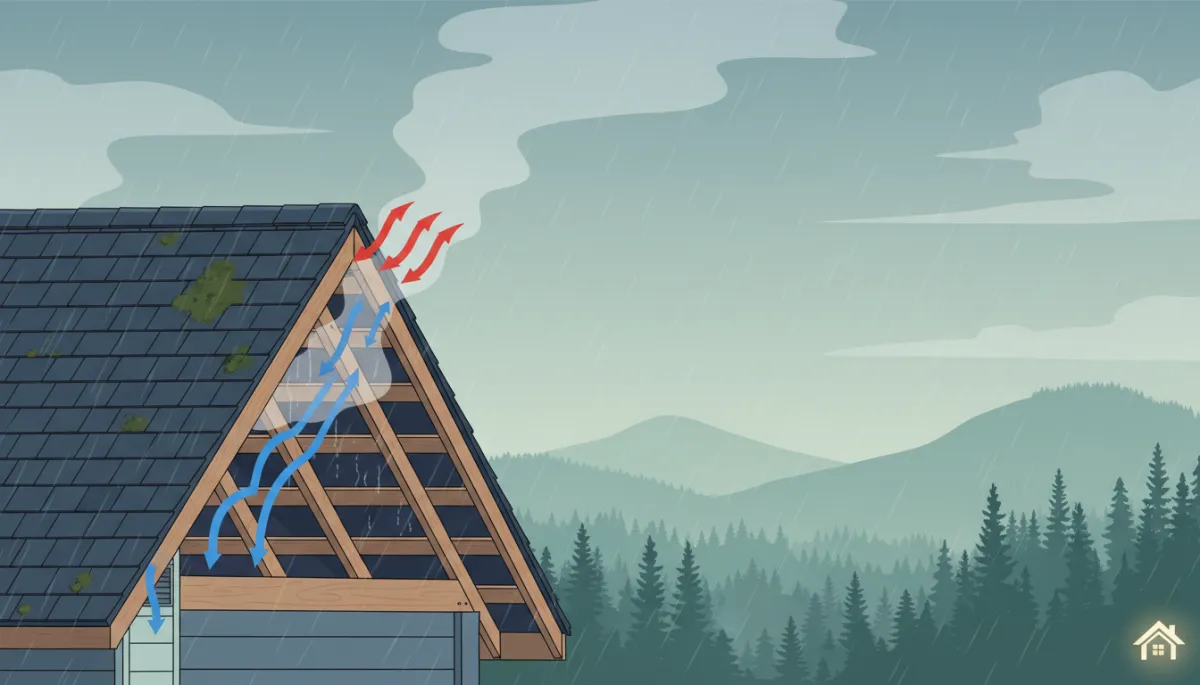
A healthy roof in Snohomish County starts with a simple concept: allow cool, dry air to enter low and let warm, moist air escape high. This continuous movement of air through the attic or rafter space is what roofing professionals call a balanced ventilation system. When designed and installed correctly, it helps control moisture, temperature, and the overall performance of your roofing system over time.
On most homes, intake ventilation is located at the soffits or eaves. These vents are placed along the lower edges of the roof, often as continuous perforated soffit panels or as evenly spaced individual vents. Their job is to bring in outside air from under the roof overhang and feed it into the attic or rafter cavities. For this to work, insulation must not be stuffed tightly into the eaves; there must be a clear air channel from the soffit into the attic, often maintained with baffles or vent chutes installed between rafters.
At the top of the roof, exhaust ventilation allows warmer, moisture-laden air to escape. In our region, this is commonly achieved with continuous ridge vents running along the peak or with individual roof vents located near the top. Because warm air rises, exhaust vents at or close to the ridge take advantage of natural convection, pulling air upward as fresh air enters at the soffits. When intake and exhaust are properly sized and balanced, you create a steady, passive airflow that does not rely on fans or electricity to protect your home.
Why Proper Ventilation Is Critical in the PNW's Humid Climate
The Pacific Northwest, including Snohomish County, experiences long, wet seasons, frequent rain, and extended periods of high humidity. According to guidance on humid climates from the U.S. Department of Energy, moisture that is not controlled can accumulate in attics and roof assemblies, leading to condensation, mold, and structural damage over time. In our region, the combination of cool outdoor temperatures and warm, moist indoor air makes this risk especially high during fall, winter, and spring (Energy.gov).
Everyday activities such as showering, cooking, running dishwashers, and even breathing release moisture into your home. Some of that warm, humid air migrates upward into the attic through light fixtures, gaps around plumbing and wiring, and other small openings in the ceiling. When it reaches the colder underside of the roof sheathing, it can condense into liquid water. Without a path for that moisture to escape, it lingers in the attic, soaking into wood, insulation, and fasteners. Proper ventilation helps dilute this humid air and move it outside before it can condense in damaging amounts, which is particularly important in climates like the PNW where outdoor humidity is already elevated (Buildings.com).
Mold, Mildew, and Rot: The Hidden Cost of Trapped Moisture
When attic moisture is not managed, the first warning signs are often subtle: a musty smell when you open the attic hatch, dark staining on the underside of the roof sheathing, or small patches of fuzzy growth on rafters. These are indications that mold and mildew are taking hold. Over time, this biological growth can spread across framing members, sheathing, and even into insulation, compromising indoor air quality and potentially triggering respiratory issues for sensitive occupants. In a damp region like the Pacific Northwest, once mold colonies are established, they tend to thrive unless conditions are corrected quickly through ventilation and moisture control (Buildings.com).
Beyond mold, chronic moisture exposure can lead to wood rot. Roof sheathing and rafters that remain damp for extended periods gradually lose their structural strength. You may notice a spongy feel when walking on the roof, sagging rooflines, or shingles that no longer lie flat because the wood beneath them has deteriorated. Repairing this type of damage often requires replacing sections of sheathing or framing, significantly increasing the cost of a roofing project. Proper ventilation, combined with appropriate air sealing and vapor control, helps keep these materials dry and extends the life of your entire roof structure, which is especially important in the PNW’s persistently wet environment (Energy.gov).
How Poor Ventilation Contributes to Ice Dams on PNW Roofs
While Snohomish County does not experience the extreme cold of some northern states, winter storms and cold snaps still bring snow and freezing temperatures. Inadequate attic ventilation can contribute directly to ice dams, which are ridges of ice that form along the roof edge and prevent melting snow from draining properly. When an attic is too warm because heat from the living space is trapped, it melts the snow on the upper portions of the roof. The meltwater flows down to the colder eaves, where it refreezes, gradually building up a dam of ice. Water then backs up behind this dam and can work its way under shingles, leading to leaks and interior water damage.
A well-ventilated attic stays closer to the outdoor temperature, reducing uneven melting on the roof surface and helping snow melt more uniformly. When combined with proper insulation and air sealing, balanced intake and exhaust ventilation can significantly reduce the risk of ice dam formation even in the variable winter conditions common across the Pacific Northwest. This is especially important on low-slope roofs and complex rooflines, where meltwater can easily become trapped if ice dams form along valleys and eaves (BuildingAdvisor.com).
Summer Heat Buildup and Premature Shingle Failure
Although the PNW is known for rain, our summers have become increasingly warm and dry, with more frequent heat waves. In an under-ventilated attic, temperatures can climb far above the outdoor air temperature on sunny days. This trapped heat radiates through the roof deck and into the shingles from below, accelerating the aging process of asphalt roofing. Over time, excessive heat contributes to shingle curling, cracking, loss of protective granules, and a general breakdown of the roofing materials, often years before the end of the manufacturer’s expected service life.
Proper ventilation helps exhaust hot air from the attic, reducing peak temperatures and creating a more stable environment for your roofing system. This not only protects the shingles but can also improve comfort in the living space below and reduce cooling costs on the warmest days. In a region where climate change is bringing more intense summer heat, investing in effective roof ventilation is a practical way to protect both your roof and your energy budget over the long term (Northwest Climate Impacts).
Ventilation Ratios Required by Washington State Code
Washington State has adopted the 2021 building and residential codes, which include specific requirements for attic and roof ventilation. For most residential roofs governed by the International Residential Code (IRC) and the state’s amendments, the minimum net free ventilating area must be at least 1/150 of the area of the space being ventilated. In practical terms, that means for every 150 square feet of attic floor area, you need at least 1 square foot of net free vent area distributed between intake and exhaust (WAC 51-50-1202).
The code allows this requirement to be reduced to 1/300 of the attic area when certain conditions are met. Specifically, you must have a Class I or II vapor retarder installed on the warm-in-winter side of the ceiling, and between 40% and 50% of the required vent area must be located in the upper portion of the roof, no more than three feet below the ridge, with the remainder at the eaves. This distribution helps ensure effective airflow from low to high. It is also important to maintain at least a 1-inch airspace between the insulation and the underside of the roof sheathing to allow air to move freely. Snohomish Roofing Company is familiar with these code requirements and can calculate the correct vent area for your specific roof configuration, ensuring both compliance and performance.
Comparing Ridge Vents, Box Vents, and Power Vents
Homeowners in the Pacific Northwest have several options for attic exhaust ventilation, each with advantages and considerations. Choosing the right system depends on your roof design, attic layout, and local climate conditions. A professional evaluation helps determine which approach will deliver balanced airflow and long-term durability in Snohomish County’s wet environment (Pacific Roofing Ventilation Guide).
Ridge vents are installed along the peak of the roof and provide continuous exhaust across the entire ridge line. When paired with adequate soffit intake, they create an even draw of air from one end of the attic to the other. Ridge vents are typically low-profile and visually discreet, blending well with most roofing styles. Because they take advantage of the natural high point on the roof, they are often considered one of the most effective passive ventilation solutions for standard gable and hip roofs in our region.
Box vents (also called static or turtle vents) are individual vents installed near the upper portions of the roof. They are useful when a continuous ridge vent is not practical, such as on shorter ridges, complex roof layouts, or where structural elements interrupt the ridge line. Multiple box vents are usually required to provide sufficient net free area, and they must be carefully spaced to avoid dead spots where air does not move effectively. In the PNW, it is important that these vents be constructed of corrosion-resistant materials and properly flashed to withstand frequent rain and wind exposure (BuildingAdvisor.com).
Power vents, or powered attic fans, use electricity or solar power to actively pull air out of the attic. In some situations, especially where passive ventilation is limited by architecture, they can help reduce heat and moisture levels. However, they must be designed carefully to avoid drawing conditioned air from the living space or creating negative pressure that pulls in moisture from unintended locations. In the Pacific Northwest, powered systems should be viewed as supplements to a well-designed passive intake and exhaust strategy, not as a substitute for meeting basic code-required ventilation ratios. Snohomish Roofing Company can help you weigh the pros and cons of these options and recommend a configuration tailored to your home and budget.
When to Upgrade Ventilation During a Re-Roof Project
The best time to correct ventilation problems is when you are already replacing your roof. During a re-roof, shingles and underlayment are removed, giving your contractor full access to the roof deck and a clear view of existing vent openings, soffit conditions, and any hidden damage. Upgrading ventilation at this stage is far more efficient and cost-effective than trying to retrofit new vents later. It also ensures that your new roofing materials are supported by the right environment from day one, which can help protect your manufacturer’s warranty and extend the life of your investment.
Before installing new shingles, Snohomish Roofing Company can calculate the required net free vent area for your attic, confirm that soffit vents are open and unobstructed, and design a balanced system using ridge vents, box vents, or a combination that suits your specific roof geometry. We can also look for signs of past moisture problems—such as staining, mold, or delaminated sheathing—and recommend repairs where necessary. If your home has older gable-end vents, bathroom fans terminating in the attic, or insulation blocking eaves, a re-roof is the ideal opportunity to correct these issues and bring your home up to current Washington State standards. For many Snohomish County homeowners, upgrading ventilation during a re-roof is one of the most cost-effective steps they can take to protect their roof, manage moisture, and improve overall home performance in the Pacific Northwest’s challenging climate.
Partner with Snohomish Roofing Company for Code-Compliant, Climate-Ready Ventilation
Roof ventilation may be out of sight, but in the Pacific Northwest it should never be out of mind. From managing humidity and preventing mold to reducing ice dams and protecting shingles from heat damage, a properly designed intake and exhaust system is essential to the long-term health of your roof. Washington’s current building codes establish clear minimum standards, but meeting the numbers on paper is only part of the equation. You also need a contractor who understands how our wet, variable climate affects real homes in Snohomish County and who can tailor solutions to your specific roof, attic, and lifestyle.
Snohomish Roofing Company offers detailed roof and attic inspections focused on ventilation performance. We evaluate soffit intake, ridge or roof exhaust, insulation levels, and any signs of moisture or heat-related damage. Then we provide clear, honest recommendations—whether that means simple improvements to existing vents, adding new intake or exhaust, or integrating ventilation upgrades into an upcoming re-roof project. A properly ventilated roof lasts longer and performs better in Snohomish County's wet climate. Contact Snohomish Roofing Company at (360) 913-2021 or visit https://snohomishroof.com — we'll inspect your ventilation and give you honest recommendations.
SEO Title: Roof Ventilation in the PNW: Why It Matters for Snohomish County Homes | Snohomish Roofing Company
Meta Description: Learn why proper roof ventilation is critical in the Pacific Northwest’s wet climate. Discover how soffit and ridge vents work, Washington State code requirements, and when to upgrade ventilation during a re-roof from Snohomish Roofing Company.
Meta Keywords: roof ventilation Snohomish County, PNW roof ventilation, attic ventilation Washington State code, ridge vents vs box vents, power attic vents, ice dams Pacific Northwest, mold in attic, Snohomish Roofing Company