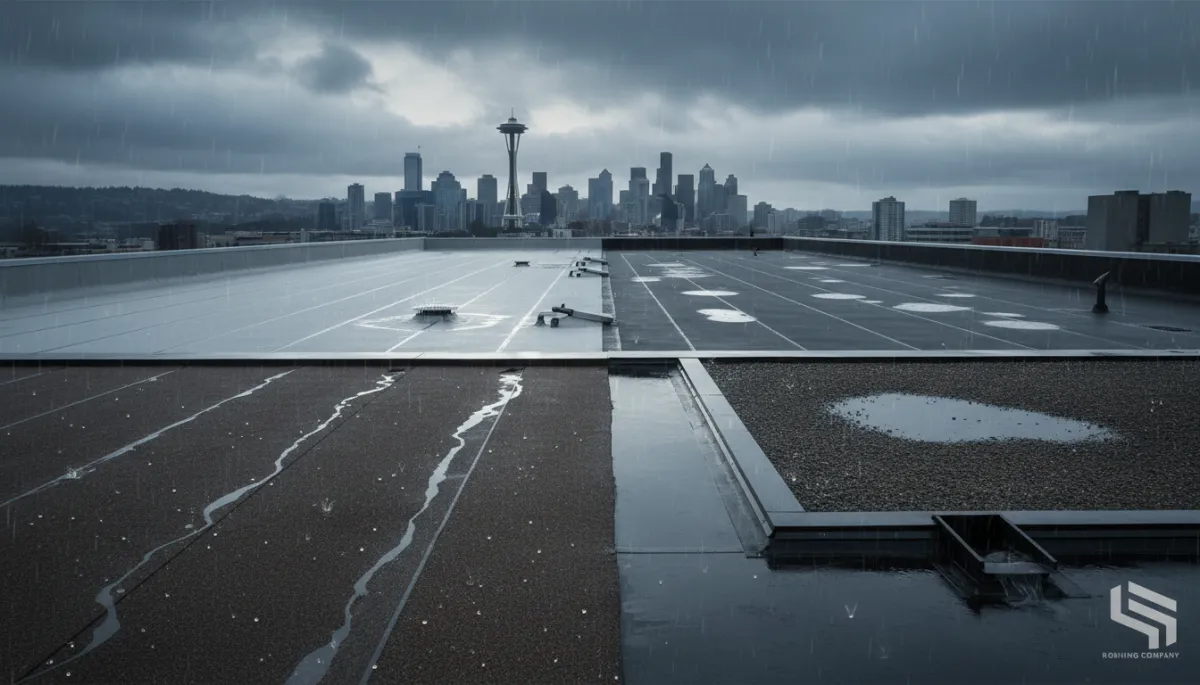
Flat Roofing Solutions for Puget Sound Businesses
Commercial Roofing, Flat Roofing, Puget Sound, Snohomish County
Flat Roofing Solutions for Puget Sound Commercial Buildings
Flat roofs on Puget Sound commercial buildings take a beating from our relentless rain and moisture. Snohomish Roofing Company provides expert flat roof installation, repair, and maintenance for businesses throughout Snohomish County. Call (360) 913-2021 or visit https://snohomishroof.com for a FREE commercial roof assessment.
Why Flat Roofs in the Pacific Northwest Demand Special Attention
Commercial properties across the Puget Sound region rely heavily on flat and low-slope roofs. They are practical for HVAC equipment, solar arrays, and easy access, but our wet, marine-influenced climate exposes every weakness in a flat roofing system. Annual rainfall commonly exceeds 36 inches, and in many locations it is well over 40 inches, with long stretches of damp weather and limited drying time. In this environment, design shortcuts or poor installation quickly translate into leaks, interior damage, and business disruption.
The primary challenge is moisture management. Flat roofs do not shed water the way steep-slope roofs do. Even a minor depression in the surface can collect water for days. Industry guidance typically defines ponding water as standing water deeper than about ¼ inch that remains longer than 48 hours. In the Pacific Northwest, where consecutive wet days are common, that kind of ponding dramatically accelerates membrane deterioration and adds unnecessary weight to the structure. Combined with frequent freeze–thaw and wet–dry cycles, this makes material selection, installation quality, and drainage design absolutely critical for Snohomish County businesses.
Core Flat Roofing Systems for Puget Sound Commercial Buildings
While there are many specialty products on the market, most commercial flat roofs in our region fall into four main system categories: TPO, EPDM, modified bitumen, and built-up roofing (BUR). Each behaves differently under Pacific Northwest rain and should be matched to the building’s use, budget, and maintenance plan.
TPO (Thermoplastic Polyolefin)
TPO is a single-ply, heat-welded membrane that has grown rapidly in popularity for commercial projects. In the Pacific Northwest, a properly installed TPO system can typically provide 20–30 years of service. Its seams are heat-welded rather than glued, creating joints that can be three to four times stronger than adhesive seams, an important advantage when rain is driving against every edge and penetration. TPO is usually white or light-colored, which reflects solar heat and can reduce cooling costs by up to roughly 15% in some studies. While summer cooling loads are not as extreme in Puget Sound as in sunnier climates, reflective TPO still helps control interior temperatures on clear days and protects the membrane from UV degradation over time.
EPDM (Rubber Roofing)
EPDM is a synthetic rubber membrane known for its flexibility and proven waterproofing performance. In wet climates similar to Seattle and Everett, well-installed EPDM roofs commonly reach 25–30 years of life. EPDM is especially forgiving of movement in the building structure, which is important as roofs expand in summer and contract in cooler months. Its main vulnerability in our climate is seam and flashing quality; failures typically occur where sheets meet or at penetrations, not in the membrane field itself. For Puget Sound businesses willing to invest in consistent inspections and prompt repairs, EPDM can deliver excellent long-term value.
Modified Bitumen
Modified bitumen systems combine asphalt with polymers to create a flexible, durable membrane, typically installed in multiple plies. Modern three-ply systems, especially cold-process applications, are highly resilient in the Pacific Northwest. With correct installation and maintenance, they often deliver around 20 years of service. Modified bitumen performs well under constant moisture exposure and is less prone to damage from occasional foot traffic, making it a solid choice for roofs with regular equipment access. As with any asphalt-based system, UV protection and proper drainage are essential to avoid premature aging, blistering, or cracking.
Built-Up Roofing (BUR)
Built-up roofing is the traditional “tar and gravel” system made of multiple layers of bitumen and reinforcing fabrics. BUR has a long track record in commercial applications and can provide robust waterproofing when installed correctly. However, BUR systems are heavier and more labor-intensive than single-ply options. In our climate, long-term performance depends heavily on consistent maintenance of the surfacing layer and ensuring that drains and scuppers remain unobstructed. Many older Puget Sound buildings still have BUR systems in place; Snohomish Roofing Company frequently evaluates these roofs to determine whether targeted repairs, coatings, or full replacement make the most financial sense.
How These Systems Stand Up to Pacific Northwest Rain
In a wet environment like Puget Sound, the real test of any flat roofing system is its ability to keep water moving and out of the building envelope. TPO and PVC membranes offer exceptionally strong, heat-welded seams that resist water intrusion, even under standing water. EPDM’s large sheet sizes reduce the number of seams, which is beneficial, but every splice and penetration must be carefully monitored. Modified bitumen and BUR rely on multiple layers and redundancy; small defects often remain localized if caught early, but neglected ponding can accelerate deterioration of the asphalt components.
Regardless of the material, poor detailing around parapet walls, rooftop units, skylights, and penetrations is a frequent source of leaks in Snohomish County commercial buildings. The combination of wind-driven rain and long periods of saturation will quickly exploit any gap or weak seal. For this reason, Snohomish Roofing Company emphasizes high-quality flashing installation and rigorous inspection of all transitions as part of both new construction and re-roofing projects.
Proper Drainage Design: The Foundation of a Reliable Flat Roof
Effective drainage is not optional on a flat roof in the Pacific Northwest; it is the core of the design. Industry best practices typically call for a minimum slope of ¼ inch per foot, created through tapered insulation or structural slope, to move water toward internal drains, scuppers, or gutters. Inadequate slope, poorly located drains, or undersized downspouts all contribute to ponding water and premature roof failure. In a region where storms can drop significant rainfall in a short period, those design details directly affect whether your roof safely sheds water or becomes a shallow swimming pool.
Snohomish Roofing Company evaluates drainage performance on every commercial flat roof assessment. This includes verifying that drains are correctly placed at low points, that overflow provisions are present where required, and that tapered insulation is directing water as intended. When needed, we recommend additional drains, re-tapering, or corrective measures to eliminate chronic ponding areas before they compromise the membrane or structure.
Ponding Water: Hidden Costs and Structural Risks
Ponding water is more than an aesthetic issue. When water sits on a flat roof for days after a storm, it increases the load on the roof deck, encourages organic growth such as algae and moss, and accelerates breakdown of many roofing materials. Over time, this can lead to sagging, leaks, and even structural concerns. In our wet climate, where drying periods may be short, the impact is amplified. Industry guides note that ponding water deeper than roughly ¼ inch and lasting longer than 48 hours is a sign that corrective action is needed, not just routine maintenance.
For commercial property owners, the costs of ignoring ponding can show up as damaged insulation, interior ceiling repairs, mold remediation, and increased insurance claims. Addressing the root cause—whether through improved drainage, localized deck repair, or adjusted slope—protects not only the roofing system but also the business operations beneath it. Snohomish Roofing Company’s flat roof specialists are trained to identify ponding patterns and propose practical, budget-conscious solutions tailored to each building.
Roof Coatings and Reflective Membranes for Extended Service Life
Roof coatings and reflective membranes are valuable tools for extending the life of an existing flat roof and improving energy performance. Elastomeric, silicone, or acrylic coatings can be applied over certain TPO, EPDM, modified bitumen, or BUR systems to create a continuous, reflective surface. In the Pacific Northwest, coatings help protect the underlying membrane from UV damage during sunny periods and can seal minor cracks or surface wear. They also make it easier to spot emerging issues, because defects stand out clearly on a uniform coated surface.
Reflective membranes, such as white TPO or PVC, reduce heat gain on clear days, which can be particularly beneficial for buildings with large rooftop equipment or sensitive interior environments. While Puget Sound is not known for extreme summer heat, reducing roof surface temperatures still contributes to longer membrane life and more stable interior conditions. Snohomish Roofing Company assesses whether a coating or reflective overlay is appropriate based on the age, condition, and type of your existing roof, as well as manufacturer warranty requirements.
Recommended Maintenance Schedules for Commercial Flat Roofs
In the Puget Sound climate, a “set it and forget it” approach to flat roofing is risky and expensive. Industry best practices and facility management guidance consistently recommend at least two professional roof inspections per year—typically in the fall before the heaviest rains and in the spring after winter weather. After severe wind or storm events, an additional check is prudent to identify debris damage or compromised flashings.
- Biannual inspections: Check seams, flashings, penetrations, and terminations; document any changes since the last visit.
- Drain and gutter cleaning: Remove leaves, branches, and debris to prevent clogs and ponding, especially near scuppers and internal drains.
- Surface repairs: Address punctures, blisters, and minor splits promptly using manufacturer-approved materials to maintain warranties.
- Vegetation control: Remove moss, algae, and any volunteer plants whose roots can damage membranes and hold moisture.
- Documentation: Keep detailed records of inspections, repairs, and any modifications to rooftop equipment or penetrations.
Snohomish Roofing Company offers maintenance programs tailored to commercial properties, helping owners budget for predictable upkeep rather than emergency repairs. Regular maintenance not only extends roof life but also supports compliance with manufacturer warranties and can reduce overall lifecycle costs significantly.
Repair vs. Replacement: Making the Right Call for Your Roof
Deciding whether to repair or replace a commercial flat roof is both a technical and financial decision. Localized leaks, minor membrane damage, or isolated ponding can often be resolved with targeted repairs and drainage improvements. In many cases, adding a coating system over a sound but aging roof can provide additional years of service at a fraction of full replacement cost. However, once a roof has widespread saturation of insulation, extensive blistering, chronic leaks, or has simply reached the end of its expected service life, replacement usually becomes the more economical long-term option.
Snohomish Roofing Company conducts thorough assessments that include core samples, moisture scans when appropriate, and detailed condition reports. We then provide clear recommendations, outlining the pros and cons of repair, restoration, or full replacement, along with budget ranges and projected lifespan. This allows Puget Sound business owners to plan capital expenditures with confidence and avoid reactive, last-minute decisions driven by emergency leaks.
Choosing a Commercial Roofer in Snohomish County
The performance of any flat roofing system in the Pacific Northwest depends as much on the installer as on the material. When selecting a commercial roofer in Snohomish County, property owners should look for several key indicators of quality and reliability:
- Local, PNW-specific experience: Choose a contractor with a proven track record installing and maintaining flat roofs in the Puget Sound climate, not just in drier regions.
- Commercial expertise: Commercial roofs require different design considerations, safety protocols, and coordination than residential projects. Verify that the roofer regularly handles buildings similar to yours.
- Manufacturer certifications: Look for certifications from major membrane manufacturers, which indicate training, quality control, and access to enhanced warranty options.
- Detailed proposals: A professional roofer should provide clear scope, materials, drainage improvements, safety measures, and warranty terms in writing, not just a lump-sum price.
- Reputation and references: Online reviews, testimonials, and references from other commercial clients in Snohomish County help confirm consistency in communication, cleanliness, and follow-through.
Snohomish Roofing Company focuses specifically on the needs of Puget Sound commercial property owners. From initial assessment through final inspection, we prioritize safety, clear communication, and workmanship that stands up to the region’s demanding climate. Whether you manage a single retail building or a portfolio of industrial facilities, our team can help you select and maintain a flat roofing solution that protects your investment for decades.
Take the Next Step to Protect Your Commercial Property
Flat roofs on Puget Sound commercial buildings must be designed, installed, and maintained with our relentless rain, moisture, and seasonal temperature swings in mind. By choosing the right system—whether TPO, EPDM, modified bitumen, or built-up—ensuring proper drainage and ponding control, and committing to a regular maintenance schedule, you can significantly extend the life of your roof and reduce unplanned downtime for your business. Partnering with an experienced local contractor is the most effective way to turn those best practices into long-term results.
Protect your Puget Sound business with a flat roof that's built for the Pacific Northwest. Snohomish Roofing Company serves commercial clients throughout Snohomish County. Call (360) 913-2021 or visit https://snohomishroof.com for a free commercial roofing assessment.
SEO Title: Flat Roofing Solutions for Puget Sound Commercial Buildings | Snohomish Roofing Company
Meta Description: Learn how TPO, EPDM, modified bitumen, and built-up flat roofing systems perform in the wet Puget Sound climate. Snohomish Roofing Company explains drainage design, ponding water, coatings, maintenance schedules, and how to choose a commercial roofer in Snohomish County.